


News & Events
'Updates'
Foals, For Sale and Jennies pages updated
'Vagabond is off to Flicka'
We are delighted that Baudet du Poitou gelding 'Vagabond d'Hamerton' (...
''Mini Mules' anyone'
Miniature Shetland Pony mare 'Kitty' owned by Jacky Pringle and Chelse...
 Back to Breeds page
Baudet-du-Poitou (Click images to enlarge in a separate window)
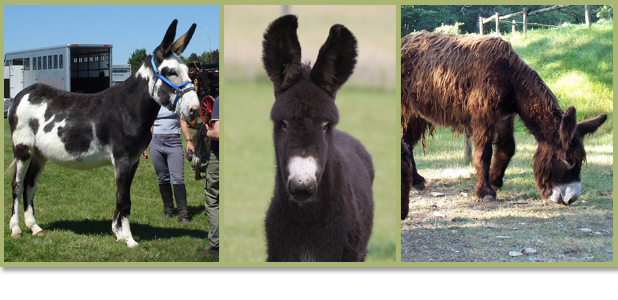
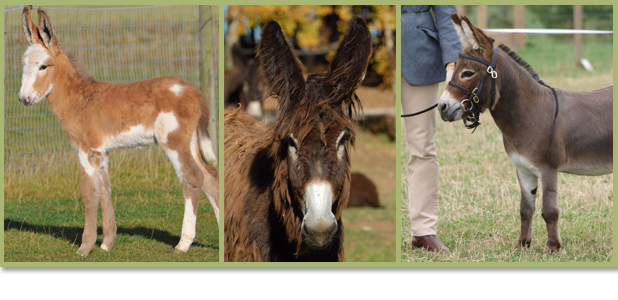
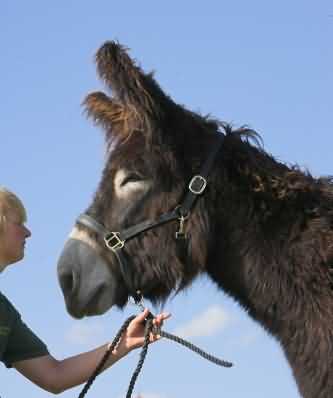 Probably the most famous and rarest breed of donkey, the Poitou takes its name from a lush and fertile French province surrounding its regional capital, Poitiers. These huge donkeys which range from 13hh to 15hh have massive heads, long ears, heavy legs and feet, and most characteristically a long, thick coat which is always brown-bay with no trace of an eel stripe. The conformation has not changed in over 400 years. Specifically bred to produce mules when crossed with a massive local heavy horse breed called the 'Trait Poitevin', the male Poitou Donkey is called the 'Baudet'. The female is the 'Anesse'. |
 The Poitevine Mule was in great demand from the middle ages
onward, and a stud book was established in 1884 to improve both
the donkey and the mulassier horse. Large numbers of mules were
used by the French army in the Congo and North Africa, and the
Poitou Donkey was exported to many countries including the USA.
But by the 1950s there was little demand for the mules as they
had been replaced by mechanized lorries, tractors and jeeps. This
was catastrophic for the donkey, and when a study was undertaken
in 1977 it was found that only around 40 animals survived, and
the Poitou Donkey was on the very verge of extinction. The Poitevine Mule was in great demand from the middle ages
onward, and a stud book was established in 1884 to improve both
the donkey and the mulassier horse. Large numbers of mules were
used by the French army in the Congo and North Africa, and the
Poitou Donkey was exported to many countries including the USA.
But by the 1950s there was little demand for the mules as they
had been replaced by mechanized lorries, tractors and jeeps. This
was catastrophic for the donkey, and when a study was undertaken
in 1977 it was found that only around 40 animals survived, and
the Poitou Donkey was on the very verge of extinction. |
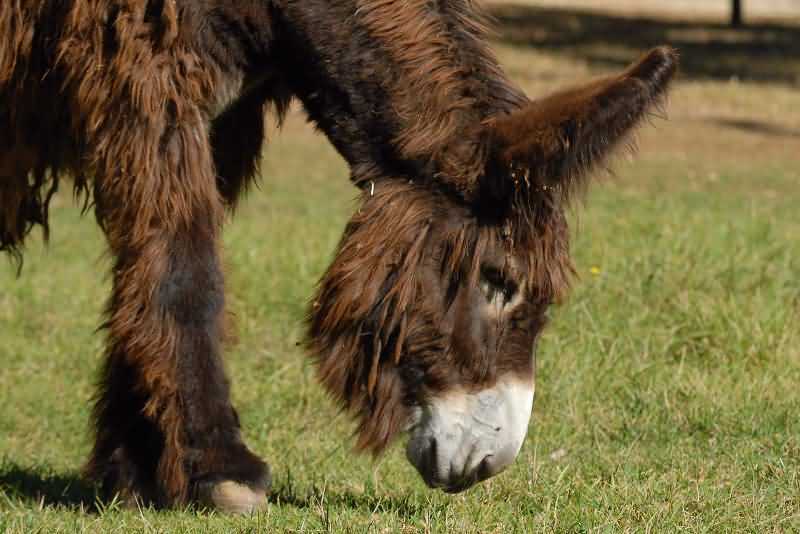 A concerted rescue plan was established in France; the Asinerie
Nationale was founded as was an association to preserve the
breed, la SABAUD ('Save the Baudet'). A breeding programme was
started with two directives, the maintenance of the original
breed in one stud book (livre 'A'), and the importation of
Portugese jennies for a carefully controlled introduction of new
blood (livre 'B'). The two stud books have now been combined
under the control of the Haras Nationale, which issues all the
pedigree certificates. Numbers have risen slowly, but today
there are still only a few hundred Poitou Donkeys in France and
a few other countries including England. All still have their
original French papers; if a donkey does not, it is not a
Poitou! A concerted rescue plan was established in France; the Asinerie
Nationale was founded as was an association to preserve the
breed, la SABAUD ('Save the Baudet'). A breeding programme was
started with two directives, the maintenance of the original
breed in one stud book (livre 'A'), and the importation of
Portugese jennies for a carefully controlled introduction of new
blood (livre 'B'). The two stud books have now been combined
under the control of the Haras Nationale, which issues all the
pedigree certificates. Numbers have risen slowly, but today
there are still only a few hundred Poitou Donkeys in France and
a few other countries including England. All still have their
original French papers; if a donkey does not, it is not a
Poitou! |